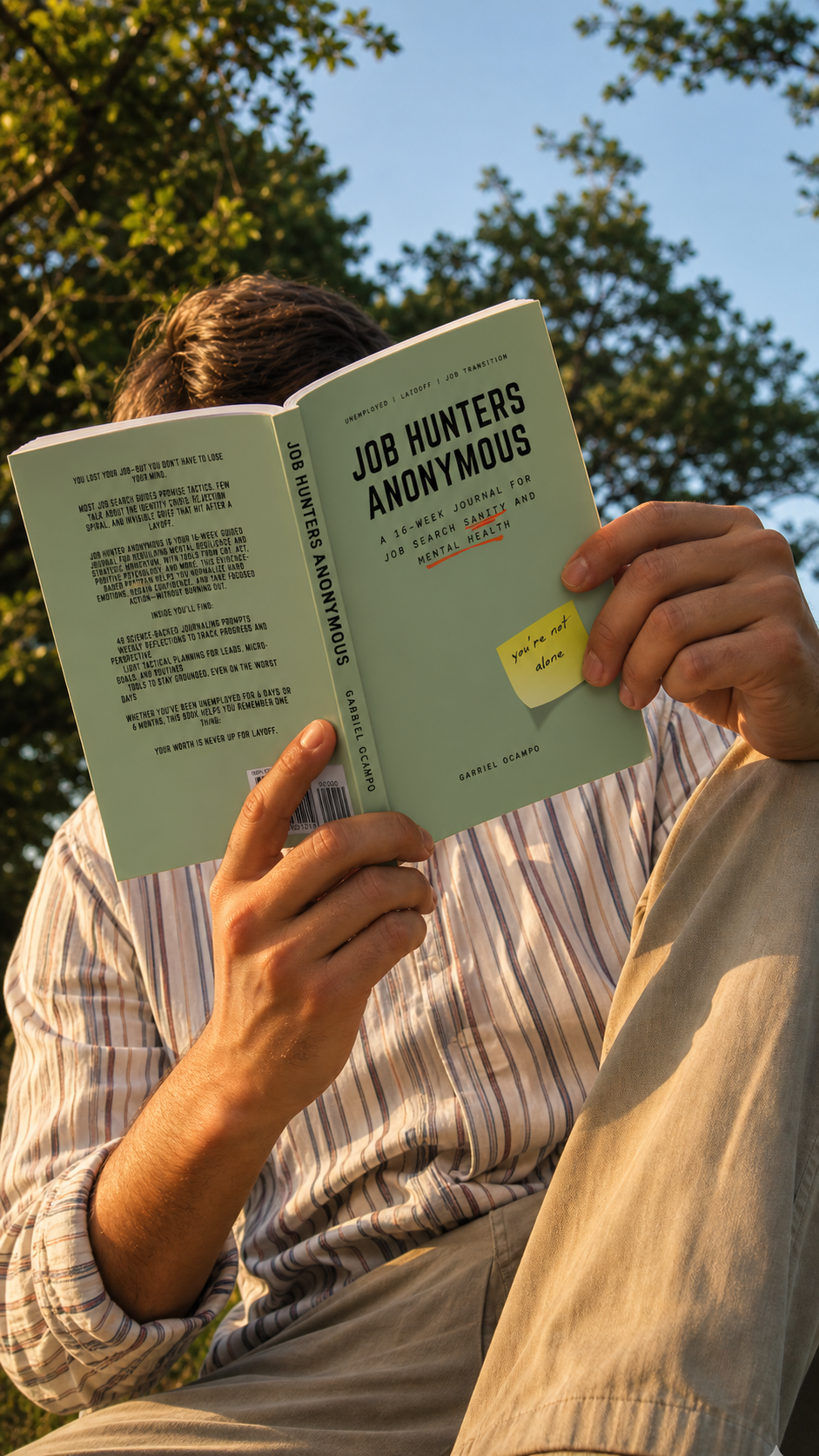
Job Hunters Anonymous — A 16-Week Journal for Job Search Sanity and Mental Health
you're not alone

Job Hunters Anonymous

A 16-Week Journal for Job Search Sanity and Mental Health

Most job search resources assume you're fine and just need better tactics. This one starts from the truth. 48 guided exercises, 16 weekly reflections, and one consistent message: your worth was never up for layoff.

16Weeks
48Exercises
4Phases
6Frameworks
What's inside

Everything a job seeker actually needs. Nothing they don't.

48

Guided Exercises

Three per week. Evidence-based, specific to the job search, and short enough to do with a coffee going cold.

16

Weekly Reflections

An inner check-in and outer progress review at the end of every week. Mood, momentum, and what comes next.

Light Tactical Structure

Micro-goal trackers, job lead snapshots, and a weekly Start/Stop/Continue — without the pressure of a rigid planner.

1.A short quote to frame the session
2.A psychological exercise based in CBT, ACT, or self-compassion
3.A mindset prompt to reframe or reflect
4.Daily goals and a micro-goal tracker
5.Today's big win — however small
6.Plan for tomorrow to close the stress loop
The 16-week structure

Four phases. One clear arc.

The journal mirrors what a job seeker actually needs emotionally — not just professionally.

Weeks 1–4 Stabilize
Week 1Shock & Self-Worth
Week 2Grounding Routines
Week 3Cognitive Reframe Basics
Week 4Resilience Stories
Weeks 5–8 Rebuild
Week 5Core Values & Direction
Week 6Strengths Spotlight
Week 7Narrative Identity
Week 8Energy Management
Weeks 9–12 Accelerate
Week 9Strategic Networking Mindset
Week 10Growth-Mindset Experimentation
Week 11Adaptive Resilience
Week 12Momentum Sprint
Weeks 13–16 Sustain
Week 13Self-Leadership Habits
Week 14Uncertainty Acceptance
Week 15Peak-Interview Prep
Week 16Transition & Celebration

Evidence-based. Not fluffy.

Every exercise in Job Hunters Anonymous draws from a real psychological framework. These aren't affirmations or generic positivity. They're tools that therapists, coaches, and researchers use to help people process difficulty and build forward momentum.

The difference between a gratitude journal and JHA is specificity. Every prompt is written for the exact emotional terrain of unemployment.

Feelings need structure too. JHA gives you both.
Cognitive Behavioral Therapy (CBT) Identifies and reframes the thought patterns that spiral into doubt and paralysis.
Acceptance & Commitment Therapy (ACT) Builds psychological flexibility — the ability to feel hard things without being controlled by them.
Self-Compassion Replaces shame and self-criticism with the kind of inner voice that actually helps you move.
Positive Psychology Uses evidence — not affirmations — to rebuild confidence through documented strengths and wins.
Behavioral Activation Breaks inertia with small, achievable actions that restore agency when motivation disappears.
Habit Design & Values Clarification Builds sustainable routines and keeps the search grounded in what actually matters to you.
Sample pages

See what a week looks like.

Week 4 — Resilience Stories

Resilience Story Bank

Create a go-to file of three personal hero moments. For each: what was hard, what you did well, one sentence you could say in an interview about it.

1.
2.
3.

"Sometimes you don't realize your own strength until you face your greatest weakness." — Susan Gale

Weekly Reflection

Inner Check-In

Overall mood this week
The moment I felt most steady
The moment I felt most off-track
If a friend had my week, I'd remind them...
New job leads this week
What recharged me most

What people ask before they start.

Job Hunters Anonymous is an educational and reflective tool. It draws from evidence-based psychological frameworks but it is not therapy and is not a substitute for support from a licensed mental health professional. Think of it as a structured companion — the kind of tool that bridges the gap between a blank journal and a coaching session.

Three entries a week is the rhythm the journal is built around — Monday, Wednesday, Friday or whatever days work best for you. You can skip a day and come back. You can write messy. The goal is consistency over perfection, and returning over finishing on schedule.

Start at Week 1 regardless of where you are in your search. The Stabilize phase is just as useful at month six as it is at day one — sometimes more so. The journal meets you where you are.

A blank journal gives you space. JHA gives you structure. Every entry starts with a specific exercise grounded in a real psychological framework. You're not staring at a blank page wondering what to write. You're working through something specific that was built for this exact experience.

Yes. JHA works well as a between-session tool for clients navigating layoffs, long searches, or career transitions. It gives clients a structured emotional practice that reinforces the work done in coaching without replacing it. Reach out if you're interested in bulk copies or partnership opportunities.

Pick it back up wherever you left off. The journal is designed to be forgiving. There's no penalty for pausing and no need to make up missed entries. The only wrong way to use it is to not come back.

Ready to start?

Pick up the journal on Amazon or try the first two weeks free.

Buy on Amazon Get Week 1 & 2 Free →